This is probably such an elementary question that I'm not sure it even qualifies as "music theory", but I feel like if I learn this it will be useful for my songwriting.
So my question is.. How do I know what key I'm playing in? I know that's a fucking stupid question but I seriously don't understand because I've never had any music lessons or anything.
I pretty much just assume that whatever chord I play the most is the key that I'm in, but I'm pretty sure that's not how it actually works.
I consider myself a pretty smart person but I don't know shit about music theory so if you could explain it like you're talking to a complete idiot that would be perfect. I do know the names of all the notes and stuff but I don't know much about scales or all that diminished suspended inverted business
I feel like I need to know this so I can get better at writing different parts for songs that have different melodies but are still in key.
I'd really appreciate some help with this
Can you guys help me out with some "music theory"?
Moderator: Ghost Hip
-
Officer Bukowski
- IAMILFFAMOUS

- Posts: 3307
- Joined: Wed Nov 17, 2010 9:13 pm
Can you guys help me out with some "music theory"?
I make pedals. SHARK TANK
-
MSUsousaphone

- IAMILF

- Posts: 2850
- Joined: Wed Dec 14, 2011 12:31 am
- Location: Lake Charles, La
- Contact:
Re: Can you guys help me out with some "music theory"?
Usually it's what note the song is centered around.....unless it's in a weird mode. BUUUUUUT.....this should help a little:
http://www.empire.k12.ca.us/capistrano/ ... atures.htm
http://www.piano-lessons-info.com/music ... tures.html
But totally forget what I said about modes. That's advanced stuff. Stick to learning the Major keys and then move to the Minor ones. Learn them for a while and then you can start messing with modes.
A key signature creates a tonal center. That means your ear is drawn to certain notes in the key. In the key of F, your ear wants you to go to the note F. In the key of G sharp, your ear leads you to G sharp.
Think of baseball when you think of a tonal center. The batter begins at home plate. His job is to go around all the basses and return to home plate to score. The tonal center of music is like home plate; we want the music to return to its tonal center. Returning to the tonal center gives us the feeling that our musical journey has ended.
http://www.empire.k12.ca.us/capistrano/ ... atures.htm
http://www.piano-lessons-info.com/music ... tures.html
But totally forget what I said about modes. That's advanced stuff. Stick to learning the Major keys and then move to the Minor ones. Learn them for a while and then you can start messing with modes.
Endorsed Artist with Myco Pedals
Myco the Website .... Myco the Facebook Page .... Myco the Flamethrower .... Myco the ILF Subforum
-
coldbrightsunlight

- Supporter

- Posts: 13666
- Joined: Tue Oct 12, 2010 12:20 pm
- Location: UK
Re: Can you guys help me out with some "music theory"?
The pattern of a major scale is: 1st (the key you're in), 2nd (+2 semitones (2 frets on a guitar)), 3rd (+another 2 semitones), 4th (+1 semitone), 5th (+2 semitones), 6th (+2 semitones), 7th (+2 semitones), 8th (which is the 1st an octave higher).
So an example using tab notation is E major: E| 0 2 4 5 7 9 11 12, or E F# G# A B C# D# E
Simple chords are formed by triads, which are like 1 3 5, 2 4 6, 5 7 9 of the notes out of the scale. So E major is E G# B, and G# minor is G# B D# etc.
Now if you look at that, the chords you can play in that key are E major, A major, B major, F# minor, G# minor, C# minor and D#dim. A song being in E major will generally only use those chords (and variations thereof like 6th and 7th chords), anything else isn't technically in the key.
A harmonically pleasing way of writing in-key melodies is to play a note from the chord that is being played at the start of a bar. You can hear the difference between playing a note out of the triad and any other note, even other notes that are in the same key/scale.
There are several different ways to play a minor scale. The simplest (natural minor) is to note that a minor scale uses the same notes as the major scale of it's 3rd. So C# natural minor just contains the same notes as E major, but starting at C# instead:
E| 9 11 12 14 16 17 19 21 or C# D# E F# G# A B C#
The harmonic minor is nearly the same, except the 7th is raised one semitone:
E| 9 11 12 14 16 17 20 21 or C# D# E F# G# A B# C# (B# is the same note (enharmonic equivalent) as C but in the key of C# minor B# is the preferred notation most of the time)
There's also the melodic minor: C# D# E F# G# A# B# C# in which the 6th is also raised a semitone. This is way less common and I've only ever seen it in music exams because it's normally played one way going up and another going down for exam scales.
Does that explain much? I can try again, sorry if that's a terrible explanation, I tried to avoid using lots of music theory terms and I'm bad at teaching. Music theory gets very interesting, and I'd definitely recommend you learn at least this basic stuff and about chord formation and cadences and stuff.
EDIT Daaaaang ninja'd, totally agree with what he said about learning the major and minor scales before anything else. Probably should have just linked to a proper article myself but screw it I typed all this out so I may as well post it now.
So an example using tab notation is E major: E| 0 2 4 5 7 9 11 12, or E F# G# A B C# D# E
Simple chords are formed by triads, which are like 1 3 5, 2 4 6, 5 7 9 of the notes out of the scale. So E major is E G# B, and G# minor is G# B D# etc.
Now if you look at that, the chords you can play in that key are E major, A major, B major, F# minor, G# minor, C# minor and D#dim. A song being in E major will generally only use those chords (and variations thereof like 6th and 7th chords), anything else isn't technically in the key.
A harmonically pleasing way of writing in-key melodies is to play a note from the chord that is being played at the start of a bar. You can hear the difference between playing a note out of the triad and any other note, even other notes that are in the same key/scale.
There are several different ways to play a minor scale. The simplest (natural minor) is to note that a minor scale uses the same notes as the major scale of it's 3rd. So C# natural minor just contains the same notes as E major, but starting at C# instead:
E| 9 11 12 14 16 17 19 21 or C# D# E F# G# A B C#
The harmonic minor is nearly the same, except the 7th is raised one semitone:
E| 9 11 12 14 16 17 20 21 or C# D# E F# G# A B# C# (B# is the same note (enharmonic equivalent) as C but in the key of C# minor B# is the preferred notation most of the time)
There's also the melodic minor: C# D# E F# G# A# B# C# in which the 6th is also raised a semitone. This is way less common and I've only ever seen it in music exams because it's normally played one way going up and another going down for exam scales.
Does that explain much? I can try again, sorry if that's a terrible explanation, I tried to avoid using lots of music theory terms and I'm bad at teaching. Music theory gets very interesting, and I'd definitely recommend you learn at least this basic stuff and about chord formation and cadences and stuff.
EDIT Daaaaang ninja'd, totally agree with what he said about learning the major and minor scales before anything else. Probably should have just linked to a proper article myself but screw it I typed all this out so I may as well post it now.
füzz lover. Friend. Quilter evangelist.
I make music sometimes:
https://nitrx.bandcamp.com/
https://mediocrisy.bandcamp.com/
https://fleshcouch.bandcamp.com
I make music sometimes:
https://nitrx.bandcamp.com/
https://mediocrisy.bandcamp.com/
https://fleshcouch.bandcamp.com
-
futuresailors

- IAMILFFAMOUS
- Posts: 8075
- Joined: Tue Oct 13, 2009 5:31 pm
Re: Can you guys help me out with some "music theory"?
Real are real.
Lazy futuresailors answer is lazy.
On the most basic level, the key will tell you which notes are sharp (or flat). So it's not necessarily which chord you play the most. ie: If you have a song with the chord progression FAmGFAmGFAmG, you're in the key of C.
This guy is the single most useful thing you'll learn:
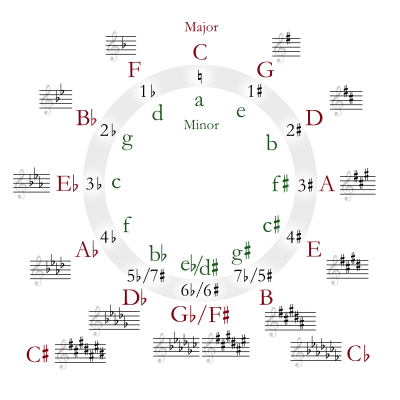
Lazy futuresailors answer is lazy.
On the most basic level, the key will tell you which notes are sharp (or flat). So it's not necessarily which chord you play the most. ie: If you have a song with the chord progression FAmGFAmGFAmG, you're in the key of C.
This guy is the single most useful thing you'll learn:
Tom Dalton wrote:You're a dumbass for making this thread to begin with.

magiclawnchair wrote:fuck that bitter old man
smile_man wrote:fuck you.ifeellikeatourist wrote: Pedals aren't everything, yada, yada, yeah I know.
McSpunckle wrote:I ctrl+f'd mountain goats and decided we aren't friends anymore.
-
devnulljp

- IAMILFFAMOUS
- Posts: 3989
- Joined: Fri Oct 09, 2009 11:29 pm
-
MSUsousaphone
- IAMILF
- Posts: 2850
- Joined: Wed Dec 14, 2011 12:31 am
- Location: Lake Charles, La
- Contact:
Re: Can you guys help me out with some "music theory"?
monkeydancer wrote:EDIT Daaaaang ninja'd, totally agree with what he said about learning the major and minor scales before anything else. Probably should have just linked to a proper article myself but screw it I typed all this out so I may as well post it now.
Whatever, man. I started typing but then realized how much work it was and lazily googled it. You get the credit for the effort. And it's well put.

Endorsed Artist with Myco Pedals
Myco the Website .... Myco the Facebook Page .... Myco the Flamethrower .... Myco the ILF Subforum
-
Officer Bukowski
- IAMILFFAMOUS
- Posts: 3307
- Joined: Wed Nov 17, 2010 9:13 pm
Re: Can you guys help me out with some "music theory"?
Bukowski is confused. This would probably be a lot easier if we were all sitting around with guitars in hand huh?
I do know the major scale. I didn't know the minor scale, but I'm gonna go pick up my guitar and reread that bit to figure it out.
I'm actually going to just try and reread all of this until I hopefully understand it a little better. It kindof all sounds like gibberish at the moment. I dunno why, but this stuff just does not come easy to me at all. I can just listen to music and play it, but if I try and read this kindof stuff it doesn't really make any sense to me.
Anyways, thanks so much guys!
I do know the major scale. I didn't know the minor scale, but I'm gonna go pick up my guitar and reread that bit to figure it out.
I'm actually going to just try and reread all of this until I hopefully understand it a little better. It kindof all sounds like gibberish at the moment. I dunno why, but this stuff just does not come easy to me at all. I can just listen to music and play it, but if I try and read this kindof stuff it doesn't really make any sense to me.
Anyways, thanks so much guys!
I make pedals. SHARK TANK
-
MSUsousaphone
- IAMILF
- Posts: 2850
- Joined: Wed Dec 14, 2011 12:31 am
- Location: Lake Charles, La
- Contact:
Re: Can you guys help me out with some "music theory"?
The next time you're playing the scale, only play up to the 7th note. Close your eyes and do it. Let it ring there for a bit. You'll notice an insane need to play the 8th (or the root) because the tonal points in that scale are all centered around that note. The Key.
Now play a 1 chord....then a 4 chord....then a 5 chord....maybe even a 57 chord after that...and just let it ring....you'll want to resolve it back to the 1. That's what it means. In a key, the tendency is to always want to go back to that root to feel complete to feel whole. Assholes that want you to feel incomplete ignore this and try to make you feel unhappy. They say that unhappiness is contemplation. That being miserable is the way to be. Don't listen to them. They are emo hipsters and they just want to bring you down. They thrive on that.
Now play a 1 chord....then a 4 chord....then a 5 chord....maybe even a 57 chord after that...and just let it ring....you'll want to resolve it back to the 1. That's what it means. In a key, the tendency is to always want to go back to that root to feel complete to feel whole. Assholes that want you to feel incomplete ignore this and try to make you feel unhappy. They say that unhappiness is contemplation. That being miserable is the way to be. Don't listen to them. They are emo hipsters and they just want to bring you down. They thrive on that.
Endorsed Artist with Myco Pedals
Myco the Website .... Myco the Facebook Page .... Myco the Flamethrower .... Myco the ILF Subforum
-
Officer Bukowski
- IAMILFFAMOUS
- Posts: 3307
- Joined: Wed Nov 17, 2010 9:13 pm
Re: Can you guys help me out with some "music theory"?
Ok I get that. That's pretty much all I've got at this point, is that feeling that I need to go to a certain note.
I'm familiar with the 1 4 5 progression. I don't really like 12 bar blues but I really like the 1 4 5 thing going on in "House Of Cards" by radiohead. Although I guess that's a bit different..
I guess what I'm really looking for is a better understanding of what chords relate to each other. So say I'm starting on a chord I want to know what other chords I basically have the option of playing within that key. So that way I can ditch the progressions that I already know and get a little more creative. I dunno if that makes any sense..
I'm familiar with the 1 4 5 progression. I don't really like 12 bar blues but I really like the 1 4 5 thing going on in "House Of Cards" by radiohead. Although I guess that's a bit different..
I guess what I'm really looking for is a better understanding of what chords relate to each other. So say I'm starting on a chord I want to know what other chords I basically have the option of playing within that key. So that way I can ditch the progressions that I already know and get a little more creative. I dunno if that makes any sense..
Last edited by Officer Bukowski on Tue Mar 13, 2012 1:27 am, edited 1 time in total.
I make pedals. SHARK TANK
-
Astricii

- experienced

- Posts: 868
- Joined: Mon Oct 12, 2009 12:27 pm
- Location: Denver CO
- Contact:
Re: Can you guys help me out with some "music theory"?
http://audio.tutsplus.com/sessions/music-theory/
This is the best place to start. has audio and is broken down into sections. you might need to focus on learning major and minor scales first but even with a basic knowledge of those this will help greatly
This is the best place to start. has audio and is broken down into sections. you might need to focus on learning major and minor scales first but even with a basic knowledge of those this will help greatly
Achtane wrote:The whole super-submissive robotic dying cat girl with mosaic for junk thing...BLEH
-
Astricii
- experienced
- Posts: 868
- Joined: Mon Oct 12, 2009 12:27 pm
- Location: Denver CO
- Contact:
Re: Can you guys help me out with some "music theory"?
Officer Bukowski wrote:Ok I get that. That's pretty much all I've got at this point, is that feeling that I need to go to a certain note.
I'm familiar with the 1 4 5 progression. I don't really like 12 bar blues but I really like the 1 4 5 thing going on in "House Of Cards" by radiohead. Although I guess that's a little different in that it's just 1 4 5 not 1 4 1 5 4 or whatever.
I guess what I'm really looking for is a better understanding of what chords relate to each other. So say I'm starting on a chord I want to know what other chords I basically have the option of playing within that key. So that way I can ditch the progressions that I already know and get a little more creative. I dunno if that makes any sense..
Scales and Chords are directly linked. learn one and you'll naturally be learning the other.
see previous post on theory lessons. Achtane wrote:The whole super-submissive robotic dying cat girl with mosaic for junk thing...BLEH
-
IEatCats

- IAMILF
- Posts: 2751
- Joined: Sun Jan 01, 2012 3:56 pm
- Location: Buffalo, NY
Re: Can you guys help me out with some "music theory"?
God damn, I forgot almost all of the technical shit behind this. I've just been playing what I think sounds good, and figuring out notes/keys when I need to communicate it to another player.
maz91379 wrote:this board is really weird sometimes bros
Amissoteomb wrote:Modern technology makes the process of purchasing erection pills even simpler and swifter than before.
-
smallsnd/bigsnd

- IAMILFFAMOUS
- Posts: 3981
- Joined: Sat Nov 29, 2008 12:57 pm
Re: Can you guys help me out with some "music theory"?
MSUsousaphone wrote:The next time you're playing the scale, only play up to the 7th note. Close your eyes and do it. Let it ring there for a bit. You'll notice an insane need to play the 8th (or the root) because the tonal points in that scale are all centered around that note. The Key.
this is excellent advice.

IEatCats wrote:I've just been playing what I think sounds good, and figuring out notes/keys when I need to communicate it to another player.
i also agree with this.
knowing what key you're in while on a particular chord is not so black and white, of course. it's about context in many cases... if you're soloing over a jazz progression, then each chord may have it's own scale associated with it - while playing a folk song probably only has the root scale attached to it.
to know what other options there are for chords within a key, just write out each chord.
in a major key, you'll have I Major, ii minor, iii minor, IV Major, V Major, vi minor, vii (half)diminished. in the key of C, that's C Major (ceg), d minor (dfa), e minor (egb), F Major (fac), G Major (gbd), a minor (ace), b dim (bdf)
add the extensions, 7, 9, 11, 13 to all of those chords for more options!
-
GardenoftheDead
- IAMILF
- Posts: 2950
- Joined: Mon Oct 31, 2011 12:26 pm
Re: Can you guys help me out with some "music theory"?
Officer Bukowski wrote:Ok I get that. That's pretty much all I've got at this point, is that feeling that I need to go to a certain note.
I'm familiar with the 1 4 5 progression. I don't really like 12 bar blues but I really like the 1 4 5 thing going on in "House Of Cards" by radiohead. Although I guess that's a bit different..
I guess what I'm really looking for is a better understanding of what chords relate to each other. So say I'm starting on a chord I want to know what other chords I basically have the option of playing within that key. So that way I can ditch the progressions that I already know and get a little more creative. I dunno if that makes any sense..
Let's look at some basic progressions:
I-IV-V
ii-V-I
I-IV-V-vi-I
The thing about chord progressions is the way they resolve the sound. The IV 'wants' to proceed to the V, which 'wants' to proceed to the I. You can put a vi after a V and it will kind of throw your ear for a loop.
http://www.theguitarsuite.com/Theory/Chord-Leading.php
-
warwick.hoy

- IAMILFFAMOUS
- Posts: 5226
- Joined: Fri Jun 11, 2010 2:34 am
- Location: Spokanistan, WA
- Contact:
Re: Can you guys help me out with some "music theory"?
I pretty much always start a song on the first scale degree and have deduced that most songs in a pop or blues based format will do the same. Therefore I usually consider the 1st note of a song to define it's key. That may not always be the case, especially in jazz (ii-V-I is seemingly common in jazz) or other more progressive genres.
This admittedly isn't the "right" way and is really just my way of keeping it simple for the purposes of making music with other musicians. The "real" way of determining key signature is looking at the number of sharps or flats in a piece, which I am very out of practice on and can be hard to determine if you are unfamiliar with your fingerboard.
If you really want to understand this stuff,....I recommend getting a piano or a cheap keyboard and taking a theory course.
This admittedly isn't the "right" way and is really just my way of keeping it simple for the purposes of making music with other musicians. The "real" way of determining key signature is looking at the number of sharps or flats in a piece, which I am very out of practice on and can be hard to determine if you are unfamiliar with your fingerboard.
If you really want to understand this stuff,....I recommend getting a piano or a cheap keyboard and taking a theory course.
Noiseprov/Pedalcore:behndy wrote:"huh. i'm on acid."
Mecha Shiva on Soundcloud.
WHY DID JOHNNY KILL? on Bandcamp. <--Beer Fund
Good Dealings with: futuresailors, Eric!, Multi_S, hatshirt, leastwise, Dr. Sherman Sticks M.D