I'm about to release a bunch of quite ambitious pedals and as such, it's time to discontinue HEDDA.
As a last hurrah, I've decided to turn the handful of remaining PCBs into something quite delightful for you.
A treat, if you will.
Everything is getting more and more expensive over here and as such, it's difficult to find really sweet sounding, cheap options and this type of occasion allows me to do my part in spreading the joy of great sounding fuzz without destroying your wallet.
HEDDA [lite] is a single foot switch, high dynamic range fuzz, with external bias and internal switching for optional output boost stages. The boost is borrowed from the CE-1 chorus pedal and sounds magnificent.
($150 USD + 29 shipping, cost will vary by territory)
New Time Shadows looks like fun. I'll keep an eye out for one next EQD sale.
Re: <<24>> is the magick number
Posted: Fri Jun 07, 2024 12:41 pm
by echorec
oldangelmidnight wrote:New Time Shadows looks like fun. I'll keep an eye out for one next EQD sale.
Now that it's a standard run, I'd like to try two in series on drum machines---one as a resonator to alter the timbre and the other as a warped delay.
Re: <<24>> is the magick number
Posted: Fri Jun 07, 2024 1:18 pm
by echorec
Glou-Glou dropped 4 pedals in their new Flancher series. They vary in delay times, but they're based around Xvive BBD chips.
Flancher is a line of 4 different stereo, analog, voltage controlled pedals. They use BBD (bucket brigade device) chips running internally at 15V and are comparable to late 70’s chorus delay studio rack units such as Roland SBF-325 or Boss DM-100.
The FL9 and FL7 are geared towards pitch modulation such as chorus, flanger, vibrato, and quasi-ring mod sounds.
The FL5B and FL5D are delays (B stands for Bright, D for Dark).
There are subtle but significant differences between the two units in each pair.
The FL9 uses a 256 stage BBD, while the FL7 uses a 1024 stage BBD. More stages means more delay time, but also more noise.
These demos show the performative aspects of this pedals---its Double function, pot-twisting to control the feedback and background chaos. They're not cheap at >$600, but they're esssentially two pedals in one with lots of CV options---dual flangers/dual delays.
(the weirder flange/vibrato sounds remind me of the Lovetone ? Flange somewhat)
Like a mega-delay or mega-reverb, Artifakt is a “one-stop shop” for all the most sought-after lo-fi effects including old vinyl replications, tape wobble and saturation, bit corruption, sample rate reduction, dark reverb and echo, filtering, compression, glitch, and more.
Skipping through this first demo, there's a lot of sound effects & noise options (gramophones/destroyed recordings...test equipment 24:00 & sci-fi blips around 33:00).
Fairfield launching a line of cv utility pedals. a bunch of passive building blocks, an envelope follower and one to give you cv control over the voltage of a power connection, which is a very cool and interesting idea with probably only a few use cases.
dub wrote:Fairfield launching a line of cv utility pedals. a bunch of passive building blocks, an envelope follower and one to give you cv control over the voltage of a power connection, which is a very cool and interesting idea with probably only a few use cases.
Interesting. I was just looking at these new offerings from Lorre-Mill and thinking they'd need some CV buddies.
The comb room effect combines a dual delay (room circuit) and a comb filter to make echo/reverb-type sounds and resonant feedback. The comb filter is in the feedback path of the delays. An envelope follower gives movement to either the comb filter or the room circuit.
Float Glass is an 8 stage voltage-controlled phaser processor with a complex modulation source. It has the potential to be used as a phaser for signals coming into the input connections as well as a generative noise instrument. The modulation source normally makes a stepped sine waveform which can be smoothed out with the slew control. A smooth sine wave is a classic modulation shape for a phaser. Float Glass also has a noise source and clipped noise source labeled sand.
Fender unveiled several models/finishes for their Player II line. (Jags, JMs, Teles, Mustangs, Jazz Basses, and more) They range from about $800-900 in the US, and several feature rosewood fretboards.
Fencer is also doing a Timber Series with bodies of pine, sassafras, and spruce. the first 2 don't interest me at all, but a spruce body could have a nice resonance.
jeez, that Jag looks yummy. too bad i don't seem to get on with Jaguars. on paper they should be perfect for me, but in real life like standard Teles they're way too bright for me, no matter how i adjust them.
Re: <<24>> is the magick number
Posted: Wed Jul 10, 2024 11:09 am
by coupleonapkins
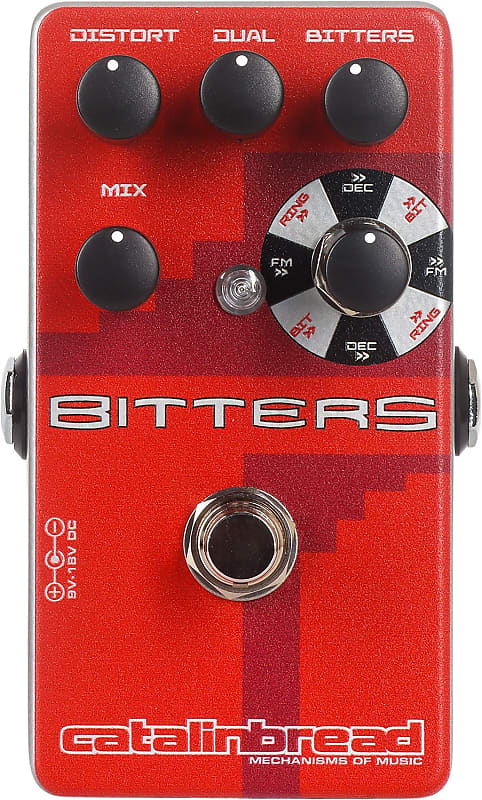
Errybuddy's on a bitcrushin' binge-o-rama, but this take on the Alesis Bitrman seems like a good idea, though I'm not keen on Catalinbreads....for now?
No vid mebbe cuz a few dealers leaked it? I dunnae care! In case/if need be here's the d'info NE Waze
Bitters
In 2004, the Alesis company released a series of effects geared towards tabletop musicians and DJs. This series was called "ModFX" and featured seven relatively pedestrian effect types, including vocoder, tremolo, compression, phaser, flanger, and filter. The seventh one, however, was a beast all its own among its ModFX peers and pedals in general. It is called the Bitrman. Our Bitters distills the madness of this circuit, fixing up the original’s shortcomings and trimming the fat to deliver an infinitely more usable version. Occupying the darkest corner of the soundscaping realm, the Bitters will give you lush, usable effects or completely render your signal into a puddle of digital mess. Just like the original, the Bitters pairs just as well with synths, drum machines, and DAWs as it does with electric guitar and bass. And since the original didn’t have a mix control of any kind, the Bitters is infinitely more usable than the original ever was. The Bitters is essentially a multi-effects device on steroids, giving you individual knobs for distortion and phaser, along with a third user-selectable program called "Bitters." This program can be one of four different effects: Decimator, Bitcrusher, Frequency Modulation, and Ring Modulation. These three effects are run in series, but you can reverse the order such that Bitters comes first for some complete sonic mayhem.
Controls:
Distort: Imparts a tastefully appointed and harmonically rich digital distortion whose gain increases as the knob is turned up. When all the way down, the distortion circuit is removed from the signal path.
Mix: Sorely missed in the original, the mix control lets you blend your pre-Bitters signal in with the output of the Bitters. Turn the control all the way down to hear just your dry signal, turn all the way up for full wet.
Bitters: The function of this knob is mode dependent, and you can select one of four different programs, listed below. Turning this knob to zero removes it from the signal path. Each program is listed twice. This lets you select the order in which these knobs occur in the signal path. The ">" symbol next to the program means that the order of the programs is "Distortion → Phaser → Bitters," while "<" means that the order is "Bitters → Phaser → Distortion."
Dual: Turning this up increases the speed of a deep sine-wave phase shifter. Like the original, this phaser ranges from slow and syrupy to a lightning fast 20 Hz, beyond the limits of most phasers. Turning this knob down decreases the rate to 0 Hz, which puts the phaser out of the circuit.
Program Wheel:
Decimator: Every manufacturer that tapped into this effect type had their own name for sample rate reduction, and this is what Alesis called it. It samples your input signal and lowers that sample rate, which introduces Nyquist aliasing.
Bitcrusher: This reduces the fidelity of the input signal all the way down to one bit for some true digital destruction. Because this also introduces noise, we’ve applied a noise gate to keep it in check.
Frequency Modulation: Otherwise known as pitch vibrato, you can dial ours down to a subtle warble (and use the mix control to get a killer chorus sound!) or let it rip and tear the signal up like Alesis intended.
Ring Modulator: Though it sounds like outer space noises, the humble ring modulator is a tremolo with an extremely fast modulation. This introduces additive and subtractive frequencies relative to the input signal and the carrier frequency.
Power Supply
The Bitters accepts a center-negative DC power supply from 9 to 18 volts.
Re: <<24>> is the magick number
Posted: Wed Jul 10, 2024 2:16 pm
by Gone Fission
dubkitty wrote:Fender is also doing a Timber Series with bodies of pine, sassafras, and spruce. the first 2 don't interest me at all, but a spruce body could have a nice resonance.
Sassafras got my attention. Fender sometimes used it in the 50s, including in some instances people would have assumed were swamp ash. The Fender Eric Johnson “Virginia” tribute model based on the 54 he sold to a collector is sassafras, since he figured out why ash Strats weren’t working the same as that one. Supposedly it is a little gritchy on clean tones but the extra frizz sits back with gain in a way that ash doesn’t. I would definitely try one in a shop to see if I think there’s anything to this. Believe me, I’d be happy to dispose of the idea as hype or just “meh.”
 (now with a bonus mode & 6 presets)


 In case/if need be here's the d'info NE Waze