Re: The NINT Molecular Clipping Overdrive Prototype
Posted: Tue Oct 28, 2014 9:57 pm
Sound great!!

The guitar pedal application was a bit of a surprise to the higher-ups maybe, hey Adam?ajbergren wrote:In principle, we want to pursue any application where molecular electronics can provide functions that are difficult or not possible with conventional components. We are always looking for new applications! Sorry the answer is so open-ended, but that is the nature of research. It can take unexpected turns at any moment (kind of like generating harmonics using the non-linearity inherent in quantum tunneling junctions!).goroth wrote:Welcome Dr Adam!
What other applications are you looking at apart from the obvious answer of MORE FUZZ!?
I love stuff like this. So Adam, do you think that particle sciences will lead to an ultimate understanding of our universe and reality? I'm gonna say yes, yes they will. And do you think that Many Worlds hypothesis is a valid explanation of quantum mysteries? Or are there no quantum mysteries, it's just formulas that civilians can't comprehend so it lends an air of mystery to it all?ajbergren wrote:Also, just stumbled upon this today..... I thought this might be of interest here, as it mentions a far-out theory to explain tunneling barriers:
http://www.nature.com/news/a-quantum-wo ... es-1.16213
I think that's great playing too, Doc! See the SD-1 on the side there.. an SD-1 with a molecular junction in it.. muchly improved.. gonna be a whole industry around taking the old diodes out of pedals and putting junctions in them!ajbergren wrote:Hi all- just a very quick preview for now..... Nick's demo will be better and available soon, but for now, here's this:
[youtube]http://www.youtube.com/watch?v=6HhMUYW7A4g[/youtube]
Please forgive my playing- this was really meant to get across the sound to the project team before we settled on a finalized circuit. Nick's demo will be much better, both at explaining the technology and at showing how they sound with a real player!
Thanks!
Now that right there is a song lyric!Ryan wrote:Distortion pedals and stars, what a time to be alive.
That is an understatement, but I have to say that they are pretty excited about this now! A few of them turned out to be guitar players, and are even evaluating the prototype!Ryan wrote:]The guitar pedal application was a bit of a surprise to the higher-ups maybe, hey Adam?
I would agree that science can provide a lot of answers, but the questions must be framed in a testable manner. That is the difficulty about some of this stuff, doing experiments that can answer some of these questions. This is what I love about science- designing experiments that will ultimately answer a question. There is a lot of creativity involved here, and this is my favourite part of my job! Certainly there will always be mysteries, but I don't think it always needs to be beyond comprehension- that is another challenge in science, communicating it to the public in a meaningful way. I have to say, Nick's demo and description should go a long way to explaining what this guitar pedal is all about in a very understandable way!!! Can't wait until that is out (it will be soon!)!Ryan wrote:I love stuff like this. So Adam, do you think that particle sciences will lead to an ultimate understanding of our universe and reality? I'm gonna say yes, yes they will. And do you think that Many Worlds hypothesis is a valid explanation of quantum mysteries? Or are there no quantum mysteries, it's just formulas that civilians can't comprehend so it lends an air of mystery to it all?
If you are interested in these concepts, you should look up the Planck length (Google it!)- that is the smallest dimension that holds any physical meaning. And it is far smaller than electrons! But the Planck length is the smallest distance that ever could hold any physical meaning- two entities (should they exist at all) separated by a distance smaller than the Planck length would technically be occupying the same space. Pretty cool concept!Ryan wrote:Another question Adam, do you think the smallest particles of existence are now known, quarks and leptons, and that's it, no smaller? Or do you think there'll be another round of discoveries beneath?
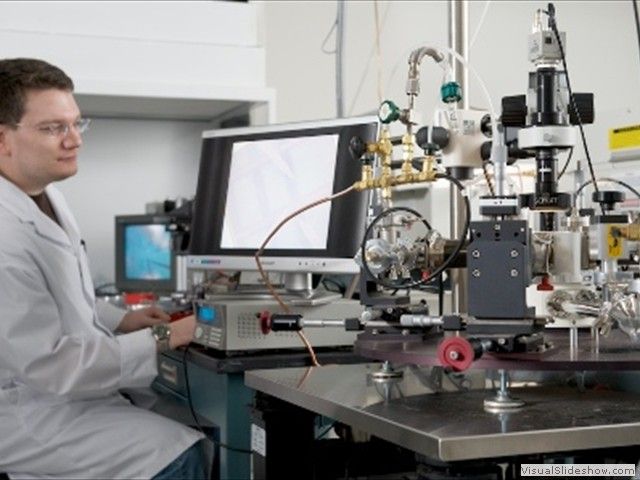
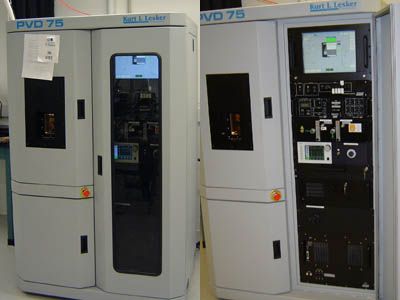
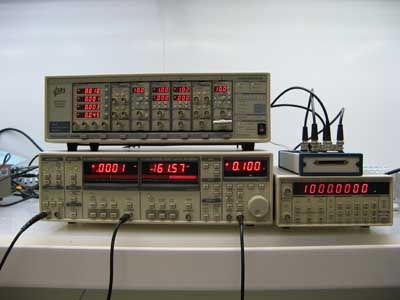
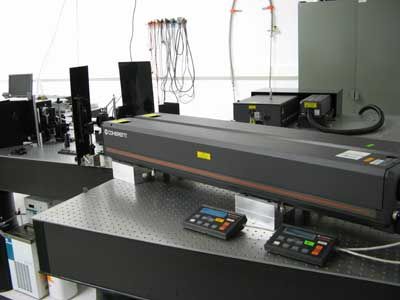
I'll work on this! We had intended to put this on the web somehow, and the current junction has reached 33 million cycles to plus/minus 1 volt since late July- no signs of slowing down! For the other equipment, I'll see what I can come up with!Ryan wrote:Maybe you could show a pic of the laptop in your lab that's processing a signal through the junctions and counting the cycles? Neat display! Or that big machine that puts the conductor on the substrate, you know these guys like gear!
No problem! The opamp with diodes is pretty cool, but my favourite is the NPN stage with junction #2- just has a really cool sound! But this illustrates exactly part of the point of doing this- providing another set of sounds for people to enjoy. There is also a second element, though- this technology is protected such that cloning issues are mitigated and I hope that new innovations are supported!!UnicornTrap wrote:That is really awesome! Thanks for the demo because I was very curious what it sounds like. loved the op-amp with the silicon diode
That's totally awesome.ajbergren wrote:That is an understatement, but I have to say that they are pretty excited about this now! A few of them turned out to be guitar players, and are even evaluating the prototype!Ryan wrote:]The guitar pedal application was a bit of a surprise to the higher-ups maybe, hey Adam?
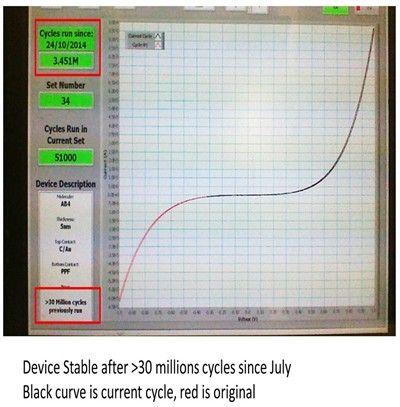
Okay, here is a snapshot from the continuous cycling experiment that has been running since approx. July. What is happening is that an instrument is cycling the voltage from -1 to +1 V over and over, and then plotting the resulting current-voltage curve relative to the first one. Here, I caught it mid-cycle, so you can see the part that is black and red on the left side. Also, it was restarted recently in order to download the data for analysis (it collects all of those curves), so in the lower left corner, it says that prior to the current set, it had already run 30 million cycles. [apologies for the low quality picture here!]Ryan wrote:
Maybe you could show a pic of the laptop in your lab that's processing a signal through the junctions and counting the cycles? Neat display! Or that big machine that puts the conductor on the substrate, you know these guys like gear!
 phanta ^