Re: What is in the post? The thread of and for GAS!
Posted: Tue Mar 29, 2011 8:25 pm
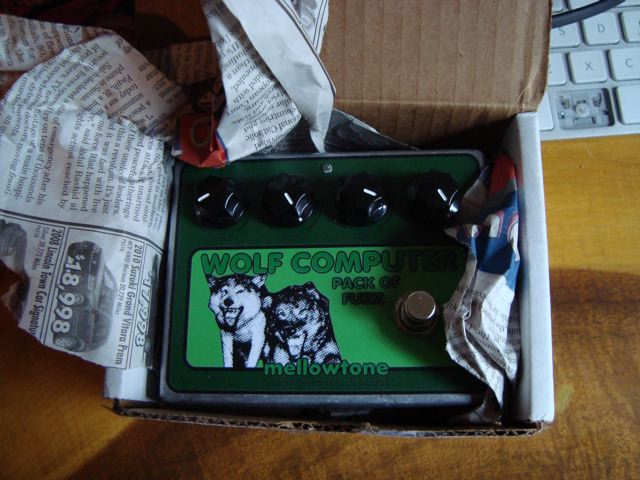
Bass Wolf!
ILF4LYF
http://ilovefuzz.com/

Mudfuzz wrote:Bass Wolf!


 What ever cap change Eric did did what ever was needed! It'd just huge sounding! WITH NO LOW LOSS ON ANY SETTING!

Mudfuzz wrote:It sounds even better then it looks!
This one's going on the board!


The White Eagle is a tailed bridge guitar, which means there’s an additional amplified string field in the tail behind the bridge of the guitar.
The instrument features two pickups. It can be used as a regular electric guitar when played mono on the normal bridge pickup.
It’s a stereo instrument and creates a beautiful audio spectrum at recording sessions when two amps are being used. A switch can change the stereo signal in a mono set up. More practical for live situations, amplifying both sections.
The string length of the tail section has a 1:4 ratio to the open string on the guitar section, causing bright overtones two octaves higher than the open string. On harmonic fret positions (5th, 7th, 12th, 19th, etc.) the tail area gives a beautiful humming harmonic overtone. On lesser consonant position such as the 6th fret the resonance is more muted. With alternate tunings you can arrange desired harmonic resonances on specific notes.
Toonster wrote:
I am doing a workshop next Wednesday to build thisThe White Eagle is a tailed bridge guitar, which means there’s an additional amplified string field in the tail behind the bridge of the guitar.
The instrument features two pickups. It can be used as a regular electric guitar when played mono on the normal bridge pickup.
It’s a stereo instrument and creates a beautiful audio spectrum at recording sessions when two amps are being used. A switch can change the stereo signal in a mono set up. More practical for live situations, amplifying both sections.
The string length of the tail section has a 1:4 ratio to the open string on the guitar section, causing bright overtones two octaves higher than the open string. On harmonic fret positions (5th, 7th, 12th, 19th, etc.) the tail area gives a beautiful humming harmonic overtone. On lesser consonant position such as the 6th fret the resonance is more muted. With alternate tunings you can arrange desired harmonic resonances on specific notes.
Source: http://www.hypercustom.com/2011brochurescreen.pdf
phantasmagorovich wrote:Great! Mine is in three weeks in Amsterdam! Do tell me how it treats you!
And Yuri is a cool guy! So you don't have to worry about it But there is fuzz allowed I guess. 
